

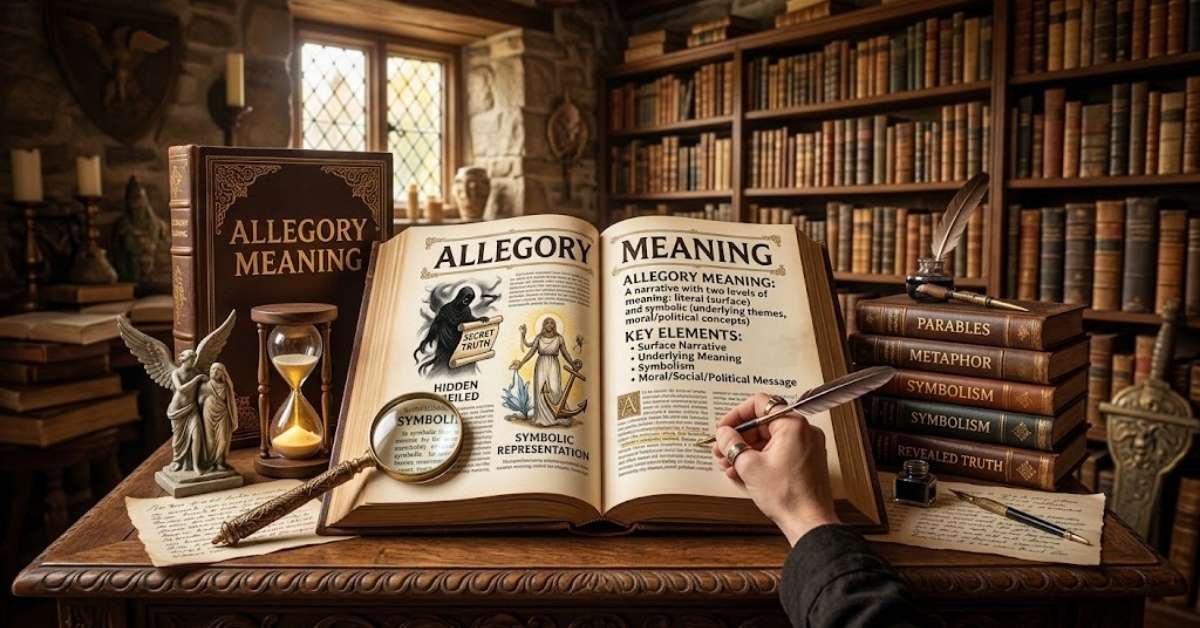
Ever finished a story and wondered, “Was that really about something else?” Maybe you’ve also tried to explain a movie to a friend and got stuck on the hidden meaning. You’re probably dealing with an allegory.An allegory is a story where characters, events, and settings stand for bigger abstract ideas. The surface tale is simple, but the deeper meaning sits underneath.
Think of it as a locked box with a story painted on the lid.This guide gives you the definition of allegory, real examples, nine types, and cultural views. You’ll also learn how to talk about it without sounding like a textbook. Grab a coffee, because this one’s easy.
Definition & Core Meaning
When people search for allegory meaning, they usually want one clear sentence. Here it is: an allegory uses symbolic representation to teach an idea through a narrative. Every piece of the story points to something real.
The word comes from the Greek allēgoria, which means “speaking otherwise.” The writer says one thing and means another. That gap is where the magic lives.
Core Meanings of Allegory
An allegory carries a layered meaning. The first layer is the plot, and the second is the moral meaning, political meaning, or philosophical meaning behind it. Good writers keep both layers alive at once.
It’s also a form of extended metaphor. A normal metaphor lasts one line, while an allegory stretches it across a whole book or film. That’s why it feels like teaching through stories instead of lecturing.
Simple Examples
Picture a tortoise and a hare racing. The animals are characters as symbols for patience and pride. The race becomes a moral lesson you’ll never forget.
Or take George Orwell’s Animal Farm. Pigs, horses, and a barn tell the story of a revolution gone sour. Kids see farm animals, and adults see authoritarian control.
Historical & Cultural Background
Allegory isn’t a trend. People have used symbols and stories for thousands of years to share ideas that felt too big or too risky to say plainly. Let’s rewind.
Ancient Meanings
In Ancient Greek philosophy, thinkers read old myths as coded lessons. Plato gave us the most famous example, the Allegory of the Cave in The Republic. Prisoners mistake shadows for reality, and one escapes to see the sun.
That tale is about illusion and knowledge, plus ethics and truth. It’s still the go-to image for how comfort can keep us blind. Later, scholars applied the same reading style to religious texts and spiritual lessons.
Cultural Interpretations
Every culture reads allegory through its own lens. A cultural interpretation depends on what a community values, fears, and remembers. The same story can land differently in Lagos, Lahore, or Lima.
That’s why cultural context matters so much. Skip it, and you’ll miss half the message. We’ll look at specific regions later.
Emotional & Psychological Meaning
Allegory doesn’t only live in classrooms. It works on feelings, too. People reach for it when plain words feel too heavy.
Identity & Self-Reflection
A story lets you see yourself from a distance. That symbolic distance makes self-reflection less scary. You might spot your own inner struggles in a lonely traveler or a trapped bird.
This is also why allegory helps with identity exploration. Two readers can finish the same tale with different personal interpretation. Both can be right, because multiple perspectives are part of the design.
Healing & Mindset
Therapists and teachers often use healing through stories. Describing grief as a house with one locked room feels safer than describing it directly. That’s a grief allegory in action, and it supports gentle trauma processing.
It also builds empathy. When you follow a character through loss, you gain emotional insight without reliving your own pain. It’s not a cure, but it can open a door. If something heavy keeps coming up for you, a counselor can help.
Different Contexts & Use Cases
You don’t need a library card to meet allegory. It shows up in your phone, your friendships, and your job. Here’s where it hides.
Personal Life
Ever told a friend, “I feel like I’m carrying a backpack full of rocks”? That’s personal allegory. You’re turning an emotion into a symbol so someone else can feel it.
Families do this too. Grandparents pass down short tales about hard work or honesty. That’s wisdom preservation without a single lecture.
Social Media
On social media storytelling, allegory hides inside captions, storytelling threads, and art posts. A photo of an empty bench might really be about modern loneliness. The audience fills in the rest.
It’s popular because it’s safe. People can share a hard feeling without naming names. That’s indirect communication at its most useful.
Relationships
In relationship communication, a small story can soften a tough talk. Saying “we’re two boats drifting apart” opens a door that “you never listen” slams shut. It’s a handy tool for difficult conversations.
A trust allegory works the same way. Compare trust to a glass vase, and your partner gets the point fast. Just keep the tone kind, and let them respond.
Professional or Modern Usage
At work, leaders use allegory in education, training, and pitches. A story about a lighthouse keeper can explain why small, steady habits matter. Teams remember stories long after they forget slides.
Filmmakers lean on it too. A film allegory like The Matrix echoes Plato’s Cave through movie symbolism. Once you see the link, you can’t unsee it.
Hidden, Sensitive, or Misunderstood Meanings
Allegory is slippery on purpose. That’s its strength and its risk. Let’s clear up a few things.
Common Misunderstandings
Many people think every story has one correct reading. In truth, multiple interpretations are normal. Others confuse allegory with plain symbolism, but allegory is a full system, not a single sign.
Another myth says allegory is only for old books. It isn’t. Modern fiction, novels, films, and media use it all the time.
What People Miss
Readers often overlook the social control angle. Allegory has helped writers criticize rulers when direct speech wasn’t safe. That’s safe expression under pressure.
An ambiguous allegory can also touch sensitive topics like faith or politics. Read with care, and don’t force your own view on the author. Ask what the story shows, not just what you wish it said.
Allegory vs. Similar Forms: A Quick Comparison
People mix these up constantly. This table keeps them straight.
| Form | What It Does | Length | Example |
| Allegory | Whole story carries a hidden message | Long or full work | Animal Farm |
| Metaphor | Compares two things in a phrase | One line | “Time is a thief” |
| Parable | Short tale with a moral or spiritual point | Brief | The Good Samaritan |
| Fable | Animals or objects teach a lesson | Brief | The Tortoise and the Hare |
| Symbolism | One object stands for an idea | A single element | A dove for peace |
| Satire | Uses irony to mock society | Varies | Gulliver’s Travels |
The big difference is scale. A symbol is one brick, while an allegory is the whole house. A parable and a fable are small allegories with a clear moral tale.
Popular Types & Variations of Allegory
Allegory comes in many flavors. Each one carries a different kind of deeper truth. Here are nine you’ll meet often.
1. Moral Allegory
This type teaches virtue and warns against vice. It’s all about right and wrong. John Bunyan’s The Pilgrim’s Progress shows a traveler wrestling with temptation on the road to salvation.
2. Political Allegory
Here, characters stand for leaders, parties, or systems. It explores power and governance and often works as political critique. Animal Farm is the classic case.
3. Religious Allegory
This form uses story to explain faith and divine truths. Parables are a close cousin. Dante’s Divine Comedy turns a journey through the afterlife into a lesson on sin and grace.
4. Philosophical Allegory
It packages tough ideas into pictures you can hold. Plato’s Cave is the star. It asks how we know what’s real, which is truth through imagination.
5. Psychological Allegory
Here, inner conflict becomes a plot. In Inside Out, emotions as symbols walk, talk, and argue. It’s psychological symbolism made friendly for kids and parents alike.
6. Social Allegory
This one tackles class inequality and other cultural issues. Snowpiercer puts rich and poor in separate train cars. The setting itself is social commentary.
7. Historical Allegory
Writers retell real historical events in disguise. Arthur Miller’s The Crucible uses the Salem witch trials to comment on 1950s fear and blame. Many allegories about revolutions follow this path.
8. Environmental Allegory
This type shows human impact on nature. Dr. Seuss’s The Lorax warns about greed and climate damage through a mustached forest guardian. It’s environmental symbolism that sticks.
9. Personal Allegory
You write this one yourself. A dream as a narrative or a story about your own life can work. It’s personal symbolism at its most honest.
How to Respond When Someone Asks About It
Maybe a teacher, coworker, or date asks, “So what do you think the story means?” You don’t need a perfect answer. You need one that fits the moment.
Casual Responses
Keep it light. Try, “I think it’s really about control, not just the farm.” Short and friendly works best here.
Meaningful Responses
Go a bit deeper when the mood allows. Point to one symbol and explain what it represents. Then say why it moved you.
Fun Responses
Humor helps. You could say, “It’s a talking-animal story that secretly roasts the government.” People will laugh, and then they’ll lean in.
Private Responses
Some meanings feel personal. You can say, “It hit close to home, but I’m still sorting it out.” That’s honest, and you don’t owe anyone more.
Regional & Cultural Differences
Different regions use allegory in their own ways. Oral storytelling and written poetry traditions both carry it. Here’s a quick tour.
Western Cultures
In Western traditions, allegory runs from Greek myth to medieval morality plays to modern literary analysis. It often targets power, faith, and reason. Orwell and Bunyan sit squarely here.
Asian Cultures
In Asian cultures, stories often aim at harmony and balance. The Chinese thinker Zhuangzi dreamed of being a butterfly and asked who the dreamer really was. India’s Panchatantra uses animals to teach smart living.
Middle Eastern Cultures
Middle Eastern traditions are rich in layered poetry. Attar’s Conference of the Birds sends birds on a quest that mirrors the spiritual traditions of the soul. Rumi’s tales work the same way, with simple scenes and deep points.
African & Latin Cultures
African cultures treasure oral storytelling, from Anansi tales that teach cleverness to proverbs that hold community values. Latin cultures gave us magical realism, where Gabriel García Márquez blurs fantasy and politics. Many Indigenous cultures also share animal tales about nature and ancestry that guide how people treat land and kin.
How to Spot an Allegory in Seconds
Not sure you’re reading one? Use this quick check:
- Odd names or labels: Characters called Hope or Greed hint at allegorical characters.
- Flat, symbolic settings: A road, a cave, or a farm feels bigger than its size.
- Repeating patterns: Allegorical events echo ideas from history or belief.
- A nagging “this feels like something else” feeling: Trust it.
Then ask three questions. What does each allegorical theme stand for? What’s the allegorical message? And who gains if you read it this way?
Tips for Writing Your Own Allegory
Want to try allegorical writing? Start with one idea, like “fear holds us back.” Pick a simple allegorical setting, such as a dark forest.
Next, assign symbols to your characters. Keep the surface story fun on its own. Readers should enjoy it even if they miss the point.
Last, don’t over-explain. Let the allegorical stories breathe. A little mystery makes people think harder.
Conclusion
Allegory is the hidden language that lets stories carry complex ideas. It teaches, protects, heals, and sometimes pokes the powerful. From Plato’s Cave to a caption on your phone, it’s everywhere.
Next time you read or watch something, pause and ask what it’s really saying. Then share your take. Which allegory changed how you see the world? Drop it in the comments, pass this guide to a friend, and check back, because we update our examples regularly.
FAQs
What is the simple meaning of allegory?
An allegory is a story where people, places, and events stand for larger ideas. It teaches a moral, political, or spiritual point through a tale. The surface story is just the doorway.
What’s the difference between allegory and metaphor?
A metaphor compares two things in a phrase or sentence. An allegory stretches that comparison across an entire story. So an allegory is basically an extended metaphor.
Is Animal Farm an allegory?
Yes. Orwell wrote it as a political allegory of the Russian Revolution and the rise of Stalin’s rule. The animals stand for real groups and leaders.
What is the most famous allegory?
Plato’s Allegory of the Cave is usually named first. It shows how people can confuse shadows with truth. Philosophers still debate it today.
Can allegory be used in everyday life?
Absolutely. You can use it in difficult conversations, social media captions, teaching, and even workplace talks. A short, kind story often beats a long explanation.
Why do writers use allegory?
It lets them share big or risky ideas in a safe, memorable way. Readers also get to interpret the message themselves. That makes the lesson feel personal.
