

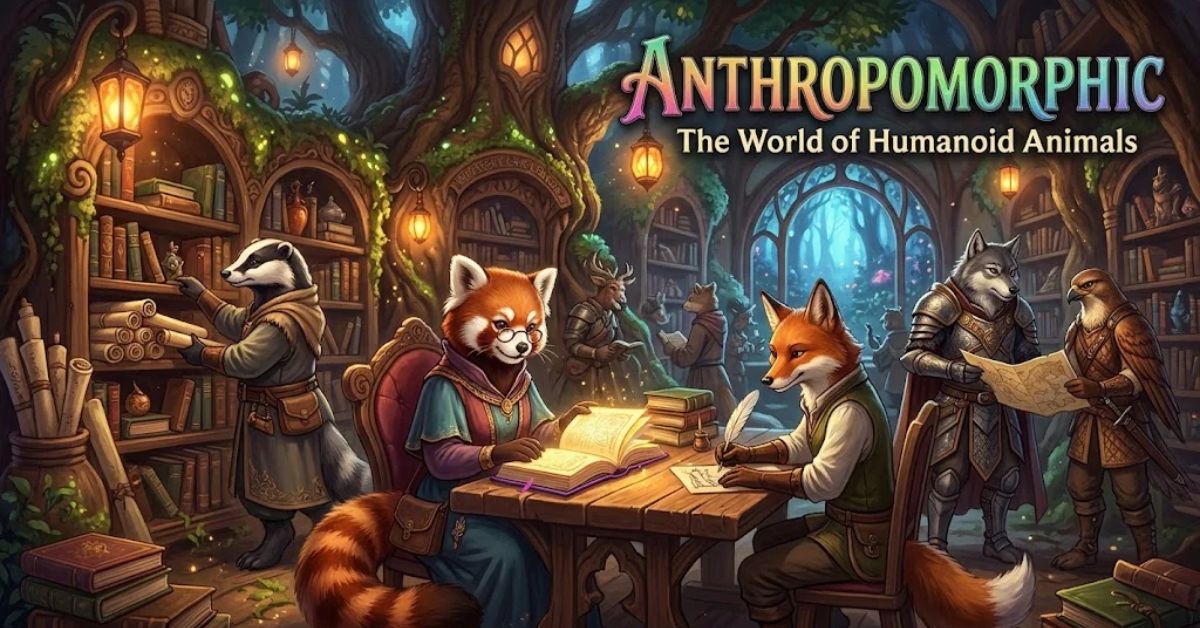
Have you ever watched a cartoon and wondered why animals talk, toys have feelings, or the sun seems to smile? These little details make fictional worlds feel alive. They also show how people give human qualities to things that aren’t human. You can spot this idea in movies, books, myths, cartoons, and even everyday conversations.
The word anthropomorphic describes something non-human that has human features, emotions, or behavior. Think of a dog that talks like a person or a robot that shows a friendly smile. These examples make ideas easier to understand and characters more relatable. But there’s more to this concept than cute cartoons. It can express deep emotions, share moral lessons, shape cultural stories, and make technology feel familiar. In this guide, you’ll learn what anthropomorphic means, explore simple examples, and see how it appears in literature, culture, and modern technology.
Definition & Core Meaning
The word anthropomorphic describes something non-human that has human characteristics, emotions, thoughts, or behaviors. These things can include animals, objects, natural forces, abstract ideas, and technology.
For example, when you say your laptop is angry or your phone doesn’t want to work, you’re giving it human traits. This idea connects to anthropomorphism, which means humanizing the non-human.
Anthropomorphic characters often show human-like reasoning, emotional capacity, and agency. They may speak, make decisions, feel jealousy, or show kindness like people do.
The term also appears in psychology, literature, religion, marketing, and pop culture. Writers use it as a storytelling tool, while brands use it to build personality and connection.
In simple words, anthropomorphic means making something seem human through its appearance, behavior, or emotions.
Core Meanings of Anthropomorphic
The core meaning of anthropomorphic centers on giving human traits to non-human entities. It helps people understand animals, objects, and ideas through familiar human experiences.
Anthropomorphism can involve physical features, emotions, intentions, or behavior. However, the non-human subject doesn’t always need a human form.
Common meanings include:
- Giving animals human emotions and thoughts.
- Making objects appear to have feelings or desires.
- Describing nature through human behavior.
- Portraying machines or robots with human-like reasoning.
- Giving abstract ideas a human personality.
For example, saying the earth is healing gives nature a human-like ability to recover. Similarly, a talking animal in a fable may teach moral lessons like a human character.
Conversation example:
- Person A: Why do you call your car stubborn?
- Person B: It refuses to start every cold morning!
The car doesn’t literally refuse. The speaker uses human traits to describe its behavior.
Key Characteristics
Anthropomorphic descriptions make non-human things feel familiar and relatable. They can involve physical appearance, emotions, thoughts, or purposeful actions.
Not every example includes all these features. A cartoon animal might walk upright, while a simple object might only seem happy or angry.
Key characteristics include:
- Human traits: The subject displays qualities commonly associated with people.
- Emotional capacity: It appears to experience love, fear, guilt, pride, or jealousy.
- Intentionality: Its actions seem purposeful rather than accidental.
- Agency and decision-making: It appears to make choices or solve problems.
- Human-like reasoning: It seems to understand situations and respond thoughtfully.
- Human form: It may have a human-shaped body, facial expressions, or clothing.
For example, a robot that talks, makes decisions, and comforts someone shows several anthropomorphic features.
However, these descriptions don’t prove that the subject has human-like consciousness. They show how people interpret or portray it.
Common Applications
Anthropomorphism appears in everyday conversations, entertainment, business, and technology. It helps people explain complicated ideas and form emotional connections with familiar subjects.
Different fields use anthropomorphic features for different reasons. A novelist might create a talking animal, while a company might design a friendly brand mascot.
Common applications include:
- Literature and storytelling: Writers use talking animals and human-like characters to share ideas.
- Religion and mythology: Stories often describe gods and deities through human emotions or divine qualities.
- Marketing and branding: Companies create brand personalities to improve relatability and engagement.
- Media and pop culture: Animated characters often think and behave like humans.
- Technology and AI: AI assistants use conversational language that can seem human.
- Education: Teachers use familiar characters to explain difficult concepts.
- Social media: Memes give animals, objects, and technology human personalities.
For example, a friendly mascot can make a company seem more approachable. However, a human-sounding AI assistant doesn’t necessarily possess emotions or consciousness.
Simple Examples
You probably use anthropomorphic language more often than you realize. People regularly describe objects, animals, and natural forces as if they have human feelings or intentions.
These expressions make ordinary situations more vivid. They can also add humor or emotion without requiring a long explanation.
Here are some simple examples:
- Angry storm: The angry storm shook the windows all night.
- Technology is learning: The robot is learning how to recognize faces.
- The software understands: The software understands what the user wants.
- The dog knew: The dog knew its owner felt sad.
- The earth is healing: The earth is healing after the wildfire.
- Fate punished him: He believed fate punished him for his mistakes.
- The wind whispered: The wind whispered through the trees.
- A stubborn object: My printer refuses to work today.
Some examples describe fictional behavior, while others use figurative language. The context helps determine how readers interpret them.
Conversation example:
- Person A: Why are you apologizing to your computer?
- Person B: It crashed again, and I’m trying to stay on its good side!
The joke gives the computer a personality it doesn’t literally possess.
Anthropomorphism vs. Personification
Anthropomorphism and personification both involve human characteristics, but they serve different purposes. They can overlap, so context matters when distinguishing them.
Anthropomorphism often portrays a non-human entity as having human-like behavior, emotions, or reasoning. This is common in cartoons, fables, and fictional stories.
Personification is a figurative language technique that gives human qualities to objects, ideas, or natural forces. Writers often use it as a poetic device to create imagery.
| Feature | Anthropomorphism | Personification |
| Main purpose | Humanize a non-human subject | Create vivid or emotional imagery |
| Common use | Stories, characters, branding | Poetry, descriptions, everyday speech |
| Example | Winnie the Pooh talks and thinks like a person | The wind whispered through the trees |
| Typical presentation | Sustained human-like behavior | Often a brief figurative expression |
For example, the animals in George Orwell’s Animal Farm speak and organize themselves like humans. That’s anthropomorphism used for social commentary.
By contrast, saying the wind whispered is usually personification. It describes the sound through a human action rather than creating a fully human character.
Historical & Cultural Background

Anthropomorphism has deep roots in human history. People have long used human-like characters to explain nature, express beliefs, and tell stories about the world.
The word’s etymology comes from the Greek terms anthrōpos, meaning human, and morphē, meaning form. Together, they convey the idea of something human-shaped.
Across different societies, anthropomorphic figures have appeared in myths, religious texts, folklore, and art. They often help people express complex ideas through familiar emotions and actions.
Ancient stories portrayed gods with human passions, while fables used talking animals to communicate moral lessons. Modern examples include animated films, mascots, and AI assistants.
Still, cultural interpretations vary. It’s important to consider each tradition’s beliefs and history rather than assuming every society uses anthropomorphism in the same way.
Ancient Context
In ancient societies, people often explained unfamiliar events through stories involving human-like beings. Gods, spirits, and animals helped communities express ideas about nature, morality, and human behavior.
Greek mythology offers well-known examples. Zeus and Hera display emotions such as jealousy, anger, love, and pride. These stories give divine figures recognizable personalities and relationships.
Ancient anthropomorphic representations also appeared in other traditions. Nature spirits and supernatural beings sometimes took human forms or displayed human intentions.
Common examples include:
- Greek gods: Zeus and Hera experience human-like conflicts and emotions.
- Nature spirits: Stories portray natural forces as beings with intentions.
- Talking animals: Fables use animal characters to teach moral lessons.
- Myths: Human-like deities help explain creation, conflict, and natural events.
- Religious texts: Some traditions describe divine qualities through human language.
These examples need careful interpretation. Not every human-like description reflects a literal belief, and different religious traditions understand divine qualities in different ways.
Anthropomorphism helped storytellers make complex subjects easier to discuss. It also gave communities memorable characters through which they could explore responsibility, kindness, power, and justice.
Cultural Interpretations
Anthropomorphism appears in many cultures, but its meaning depends on local traditions, beliefs, and storytelling practices. Literature, folklore, religion, and media all shape how people portray non-human entities.
For example, some Western stories feature talking animals that solve problems or teach lessons. Asian cultures also have rich traditions of animal characters, spirits, and human-like figures in folklore and popular media.
Japanese media offers moe anthropomorphism, where objects, machines, or concepts become appealing human-like characters. Anime and games may turn vehicles, historical ideas, or everyday objects into characters with distinct personalities.
Other traditions use human-like representations of nature, ancestors, or spiritual beings. Indigenous cultures are diverse, so their beliefs should be understood within their own cultural contexts rather than grouped into one general explanation.
Consider these examples:
- Western cultures: Talking animals appear in fables, novels, and animated films.
- Asian cultures: Folklore and media portray animals and supernatural beings with human traits.
- Middle Eastern cultures: Folklore and religious traditions offer varied ways to discuss human and divine qualities.
- African cultures: Many storytelling traditions use animal characters to convey wisdom and moral lessons.
- Latin cultures: Folklore and popular storytelling feature symbolic creatures and supernatural figures.
These examples show how anthropomorphism can support storytelling, identity, and cultural expression. However, each example needs its own historical context. Similar characters can carry very different meanings across communities.
Emotional & Psychological Meaning
Anthropomorphic thinking isn’t just about stories or talking animals. It also reflects how people understand emotions, build connections, and interpret the world around them.
When you give human characteristics to non-human entities, you may find them easier to understand. For example, calling a computer stubborn can make a frustrating moment feel less serious.
In psychology, anthropomorphism can act as a cognitive tool. It helps people interpret unfamiliar situations through familiar human experiences.
People may attribute emotions, intentions, or human-like reasoning to animals, objects, and technology. However, these impressions don’t always prove that something has human-like consciousness.
Anthropomorphism can also influence empathy, imagination, and perception. It may create comfort during lonely moments or strengthen sentimental attachment to meaningful objects.
Identity & Connection
People often connect emotionally with things that reflect their experiences, memories, and identity. Anthropomorphism can make these connections feel stronger.
For example, a child might treat a favorite toy as a trusted friend. An adult might name a car and speak to it during a stressful commute.
These habits can make everyday life feel more personal. They also help people express emotions that might otherwise feel difficult to explain.
Anthropomorphism can encourage empathy toward animals and fictional characters. It may also reduce emotional distance between people and unfamiliar technology.
Common examples include:
- Giving pets human personalities and feelings.
- Naming cars, computers, or other favorite objects.
- Imagining a fictional character understands your struggles.
- Treating a childhood toy as a source of comfort.
- Connecting personal memories with meaningful objects.
Conversation example:
- Person A: Why do you still keep that old teddy bear?
- Person B: It feels like an old friend who has been with me forever.
The teddy bear doesn’t literally understand friendship. However, its sentimental value gives it a special place in the owner’s life.
Healing & Mindset
Anthropomorphism can sometimes help people manage difficult emotions. Giving an object or character human traits may provide comfort during stressful periods.
Children often use imagination to process experiences and understand feelings. A child might tell a toy about a frightening day because talking to it feels safe.
Adults also use similar habits. Someone might speak to a pet after a difficult meeting or imagine a fictional character encouraging them through a challenge.
These experiences can support emotional expression, although anthropomorphism isn’t a substitute for professional mental health care when someone needs it.
Here are some everyday examples:
- Talking to a pet after an exhausting day.
- Giving a stuffed animal a comforting personality.
- Imagining a friendly robot offering encouragement.
- Describing a garden as healing after a difficult season.
- Using fictional characters to discuss fear, guilt, or pride.
Conversation example:
- Person A: Why are you talking to your plants?
- Person B: It helps me slow down and feel calmer.
This habit may support relaxation and a positive mindset. The benefit comes from the person’s experience, not proof that the plants understand their words.
Different Contexts & Use Cases
Anthropomorphism appears in many parts of daily life. People use it in casual conversations, relationships, entertainment, marketing, education, and modern technology.
Its purpose changes with the situation. A writer might use human-like animals to teach a lesson, while a company might create a friendly mascot to attract customers.
You can also find anthropomorphic language in social media posts and memes. People often describe weather, software, or household objects as if they have emotions.
Common contexts include:
- Personal conversations about pets and everyday objects.
- Social media posts featuring expressive animals or objects.
- Relationships built around shared jokes and sentimental items.
- Marketing campaigns that give brands recognizable personalities.
- AI assistants that communicate in natural, human-like language.
Understanding the context helps you recognize whether an example involves literal fictional behavior, figurative language, or emotional projection.
Personal Life
Anthropomorphism often appears in ordinary conversations without people thinking much about it. You might call your alarm clock cruel, your car stubborn, or your coffee machine moody.
These expressions give everyday objects a personality. They also make frustrating situations easier to describe with humor.
Pets are another common example. Owners may interpret a dog’s behavior as guilt, jealousy, excitement, or affection because these emotions seem familiar.
Some interpretations may reflect real animal emotions, while others may project human motives onto animal behavior. Context and evidence matter.
Common examples include:
- Saying your phone is having a bad day.
- Calling a slow computer lazy.
- Describing a dog as jealous of a new pet.
- Telling a toy to behave.
- Saying the weather refuses to cooperate.
Conversation example:
- Person A: Why did you yell at your printer?
- Person B: It jammed again right before my meeting!
The printer doesn’t understand the complaint. Still, humanizing the machine makes the speaker’s frustration easy to understand.
Social Media
Social media gives anthropomorphism plenty of room to shine. Users turn animals, objects, and technology into entertaining characters through captions, videos, and memes.
A cat might appear offended by its owner’s behavior. A phone might become the villain in a funny post about a dead battery.
Brands also use anthropomorphic mascots to build recognition and encourage engagement. These characters can make products feel friendly and approachable.
Popular examples include:
- Memes showing a tired laptop as an exhausted worker.
- Videos that portray pets as jealous roommates.
- Cartoon food characters with human expressions.
- Animated mascots that speak directly to viewers.
- Posts joking that technology is learning to hate its owner.
Conversation example:
- Person A: Why does this meme say my Wi-Fi is angry?
- Person B: Because it always disconnects when I need it most!
Anthropomorphic humor works because viewers recognize the situation. Giving an object human emotions turns a common annoyance into a relatable joke.
Relationships
Anthropomorphism can shape how people connect with pets, fictional characters, and meaningful possessions. These connections often grow through shared experiences and emotional memories.
Pet owners may describe their animals as protective, jealous, or understanding. Some interpretations may reflect observable behavior, but human motives shouldn’t automatically explain every animal action.
Objects can also carry sentimental value. A gift from a loved one might feel like a comforting presence long after that person has left.
Fictional characters can create similar connections. Readers may feel understood by a character who faces familiar fears or struggles.
Examples include:
- Treating a pet as a trusted companion.
- Keeping a gift because it feels connected to someone special.
- Talking about a fictional character as an old friend.
- Giving a shared household object a funny personality.
- Using affectionate names for meaningful possessions.
Conversation example:
- Person A: Why do you say your dog knows when you’re sad?
- Person B: He often sits beside me when I cry.
The dog’s behavior may reflect sensitivity to the owner’s cues. Calling it understanding expresses the owner’s emotional interpretation of that behavior.
Professional or Modern Usage
Anthropomorphism plays a useful role in business, education, science communication, and technology. Organizations use human-like traits to make products and ideas easier to understand.
In marketing, brand personalities help customers connect with products. Friendly mascots can make a business seem approachable and memorable.
Technology offers another example. AI assistants use conversational language, while robots may display facial expressions or human-like movements.
However, human-like communication doesn’t automatically indicate consciousness. A system may produce helpful responses without experiencing emotions as humans do.
Common professional applications include:
- Marketing: Giving brands recognizable personalities.
- Education: Using talking characters to explain difficult ideas.
- AI and software: Designing assistants that communicate naturally.
- Robotics: Creating machines with human-like movements or expressions.
- Science communication: Describing complex processes in familiar terms.
Conversation example:
- Person A: The software understands what I need.
- Person B: It may recognize your request and respond based on its programming.
Anthropomorphic wording can make technology easier to discuss. In professional settings, precise language helps separate a system’s actual abilities from human assumptions.
Hidden, Sensitive, or Misunderstood Meanings
Anthropomorphism can seem simple, but its meaning depends on context. Some people use it for humor, while others use it to express emotion or explain unfamiliar ideas.
A common mistake is assuming that every human-like description reflects a literal belief. Saying the wind is angry usually describes its intensity rather than claiming it experiences anger.
Another mistake is treating all anthropomorphic thinking as inaccurate. Humanizing a character can improve storytelling, while projecting unsupported intentions onto a real animal may lead to misunderstandings.
The key is to recognize the difference between imagination, figurative language, and evidence-based claims.
Common Misunderstandings
Several misconceptions can make anthropomorphism harder to understand. Recognizing these mistakes helps you interpret examples more accurately.
Misunderstanding 1: Anthropomorphism is only for children.
Adults use anthropomorphic language in humor, branding, relationships, and everyday conversations. It isn’t limited to toys or cartoons.
Misunderstanding 2: Anthropomorphism and personification mean exactly the same thing.
They overlap, but anthropomorphism often involves sustained human-like behavior. Personification frequently uses human traits as a figurative or poetic device.
Misunderstanding 3: Every anthropomorphic example is scientifically wrong.
Human-like descriptions can be useful in storytelling and communication. Problems arise when assumptions replace evidence in scientific explanations.
Misunderstanding 4: Human-like behavior proves consciousness.
A robot may speak naturally without experiencing human emotions. Its appearance or language alone cannot establish human-like consciousness.
Misunderstanding 5: Anthropomorphism always means giving something a human body.
An entity can seem anthropomorphic through its emotions, intentions, or decisions without looking human.
Conversation example:
- Person A: My AI assistant sounds caring. Does it feel concern?
- Person B: Not necessarily. Human-like language doesn’t prove that it experiences emotions.
What People Miss
The deeper value of anthropomorphism lies in how it shapes human perception. It reveals how people use familiar experiences to interpret animals, objects, technology, and abstract ideas.
People may project emotions onto unfamiliar things because human feelings provide an easy frame of reference. This process can encourage imagination, empathy, and connection.
However, anthropomorphism also has limits. Assuming a machine has intentions or believing an animal understands every human thought can create inaccurate expectations.
To understand it clearly, consider three questions:
- What traits are being assigned? Look for human emotions, intentions, reasoning, or behavior.
- Is the example literal or figurative? A talking cartoon animal differs from an angry storm in a poem.
- What evidence supports the interpretation? Separate observable behavior from assumptions about thoughts or feelings.
Conversation example:
- Person A: The earth is healing after the wildfire.
- Person B: That’s a powerful expression for nature recovering over time.
The phrase gives nature a human-like ability to heal. It communicates a real process through familiar emotional language.
Ultimately, anthropomorphism is neither automatically helpful nor harmful. Its value depends on how people use it, what they mean, and whether their interpretation fits the evidence.
Comparison Section
The word anthropomorphic describes something non-human that has human traits, emotions, or behavior. However, it can overlap with other ideas, such as personification, zoomorphism, and anthropocentrism.
Each term has a different meaning. Understanding these differences helps you use them correctly in writing, psychology, religion, and everyday conversations.
| Term | Meaning | Example |
| Anthropomorphism | Giving human traits to non-human things | A robot expresses sadness. |
| Personification | Describing something non-human through human actions or qualities | The wind whispered. |
| Zoomorphism | Giving animal traits to humans or other things | A brave warrior fights like a lion. |
| Anthropocentrism | Viewing humans as central or most important | People judge nature mainly by its value to humans. |
| Animism | Believing that spirits or spiritual qualities exist in nature and objects | A community believes a river has a spirit. |
Conversation example:
- Alex: Why does the cartoon moon look sad?
- Sam: That’s anthropomorphism. The artist gives the moon a human emotion.
Popular Types & Variations of Anthropomorphic
Anthropomorphism appears in many areas of life. Writers use it to tell stories, while businesses use it to make brands more relatable. People may also assign human emotions to pets, technology, or nature.
These variations share one main idea: they give human traits to non-human entities. However, each type serves a different purpose.
Common types include:
- Literary anthropomorphism in books and stories.
- Psychological anthropomorphism in human perception.
- Religious anthropomorphism in beliefs about deities.
- Cultural anthropomorphism in traditions and media.
- Marketing anthropomorphism in branding.
- Technological anthropomorphism in robots and AI.
- Childlike, environmental, and moral anthropomorphism.
Conversation example:
- Alex: Why does this robot act like a person?
- Sam: It uses technological anthropomorphism to feel more familiar.
1. Literary Anthropomorphism
Literary anthropomorphism gives human thoughts, feelings, speech, and behavior to animals, objects, or other non-human characters. Writers use it to make stories more engaging and easier to understand.
Talking animals in fables often teach lessons about honesty, pride, or kindness. Famous examples include Winnie the Pooh and Mickey Mouse. George Orwell’s Animal Farm also uses human-like animal characters to explore political ideas.
This storytelling tool helps readers connect with characters. It can also turn complex ideas into simple, memorable scenes.
Common examples include:
- A fox tricks other animals through clever speech.
- A toy feels jealous when a child chooses another toy.
- A tree shares its memories with a traveler.
Conversation example:
- Mia: Why can the animals talk in this story?
- Leo: The author uses anthropomorphism to make the message easier to understand.
2. Psychological Anthropomorphism
Psychological anthropomorphism happens when people interpret non-human things through human feelings, intentions, or reasoning. It is a common part of how people make sense of the world.
For example, you might say your dog looks guilty after knocking over a plant. You may also feel that your car is being stubborn when it refuses to start. These reactions reflect how people interpret behavior, though they do not always prove what another being actually feels.
Anthropomorphism can help people form emotional connections. It may offer comfort during loneliness or make unfamiliar technology feel less intimidating.
People may anthropomorphize:
- Pets and wild animals.
- Cars, toys, and everyday objects.
- AI assistants and smart devices.
Conversation example:
- Sara: My laptop hates me today.
- Ben: Maybe it just has a technical problem!
3. Religious Anthropomorphism
Religious anthropomorphism describes deities or spiritual beings through human qualities, emotions, forms, or actions. Stories may portray a god as speaking, feeling anger, showing love, or making decisions.
Greek mythology provides familiar examples through Zeus and Hera. Many myths describe divine figures with personalities and relationships that people can understand. Other religious traditions use different forms of imagery and language to discuss divine qualities.
Interpretations vary widely. Some believers understand these descriptions literally, while others see them as symbolic expressions of ideas beyond ordinary human experience.
Religious anthropomorphism may appear through:
- Human-shaped images of deities.
- Stories about divine love or anger.
- Descriptions of gods speaking or making choices.
Conversation example:
- Alex: Why does this myth describe a god with human emotions?
- Noor: The story uses familiar human traits to express divine actions.
4. Cultural Anthropomorphism
Cultural anthropomorphism appears when communities represent animals, objects, spirits, or natural forces with human characteristics. These representations often reflect local stories, values, beliefs, and traditions.
Folklore may feature talking animals, while popular media creates human-like characters from familiar cultural symbols. Japanese anime and related media, for example, sometimes give human personalities to animals, objects, or abstract concepts. The style known as moe may encourage affection for cute, appealing characters.
Different cultures use these ideas in different ways. It is important not to assume that all Western, Asian, African, Middle Eastern, Latin, or Indigenous traditions share the same beliefs.
Common examples include:
- Animal characters in traditional folktales.
- Human-like nature spirits in local stories.
- Personified symbols in festivals and media.
Conversation example:
- Mia: Why does this story show the river as a wise person?
- Amir: That character may reflect the culture’s way of expressing respect for nature.
5. Marketing Anthropomorphism
Marketing anthropomorphism gives a brand, product, or company human-like traits. Businesses use this approach to make products more memorable and relatable.
A brand might seem friendly, confident, playful, or caring. Mascots often make this technique easy to recognize. A smiling cereal character, for example, can make a product feel welcoming to children and families.
Brand personalities also help businesses create a consistent image across advertisements and social media. However, a friendly character does not automatically mean a company behaves ethically or understands its customers.
Common examples include:
- A cartoon mascot that talks to shoppers.
- An animated package with a smiling face.
- A brand voice that sounds warm and helpful.
Conversation example:
- Alex: Why does this company’s mascot talk like a friend?
- Jamie: It uses anthropomorphism to build familiarity and engagement.
6. Technological Anthropomorphism
Technological anthropomorphism gives human-like qualities to machines, software, robots, or artificial intelligence. Designers may use voices, facial expressions, names, and conversational language to make technology easier to use.
A smart assistant might say, “I’m happy to help,” while a robot may display a smiling face. People may also say, “The software understands me” or “Technology is learning.” Such phrases can describe how a system appears to behave, but they do not prove human-like consciousness.
This distinction matters as AI becomes more common. A system may generate helpful responses without experiencing emotions as humans do.
Examples include:
- A robot that waves or smiles.
- A virtual assistant that speaks conversationally.
- Software designed to respond in a friendly tone.
Conversation example:
- Sara: Does my AI assistant really care about my problem?
- Ben: It can respond supportively, but that doesn’t prove it feels care like a person.
7. Childlike Anthropomorphism
Childlike anthropomorphism occurs when children give human feelings, intentions, or personalities to toys, animals, and objects. A child might believe a teddy bear feels lonely when left on a shelf or that the sun follows them home.
Imagination plays an important role in this kind of thinking. It can support pretend play, storytelling, and emotional expression. Children may also use familiar human ideas to explain things they do not fully understand yet.
Not every child interprets these situations literally. Some knowingly pretend that toys can talk, while others may be unsure about what objects can actually feel.
Common examples include:
- Giving a stuffed animal a name and personality.
- Apologizing to a toy after dropping it.
- Imagining that clouds are racing across the sky.
Conversation example:
- Child: My teddy is sad because I left him alone.
- Parent: You care about Teddy. Shall we tuck him into bed?
8. Environmental Anthropomorphism
Environmental anthropomorphism gives human traits or actions to nature, weather, and the Earth. People often use these expressions in poetry, everyday speech, campaigns, and environmental storytelling.
Phrases such as “the wind whispered,” “the angry storm arrived,” or “the Earth is healing” make natural events feel more personal. They can create vivid imagery and encourage people to care about the environment.
However, these expressions are usually figurative. A storm does not need human anger to cause damage, and the Earth does not necessarily heal with human intentions. Scientific explanations still matter when discussing natural processes.
Examples include:
- The ocean swallowed the shore.
- The forest welcomed the hikers.
- The Earth is asking us to protect it.
Conversation example:
- Alex: Can the Earth really feel tired?
- Sam: That’s a metaphorical way to describe environmental damage, not a scientific claim.
9. Moral Anthropomorphism
Moral anthropomorphism gives human intentions, values, or moral qualities to non-human entities. It often appears in fables, myths, stories, and everyday expressions about fairness or punishment.
For example, a story might say, “Fate punished him,” or describe a fox as dishonest. These descriptions can help readers understand ideas about right and wrong. Animal characters may represent greed, courage, loyalty, or pride without requiring a long explanation.
However, a character’s behavior should not be confused with evidence that a real animal or object makes human moral judgments. The meaning often depends on the story’s symbolism and purpose.
Common examples include:
- A greedy wolf learns to share.
- A talking tree rewards a kind child.
- A story portrays fate as a judge.
Conversation example:
- Mia: Why does the story make the fox dishonest?
- Leo: The author uses an animal character to teach a moral lesson.
How to Respond When Someone Asks About It
When someone asks about the anthropomorphic meaning, explain it in simple words. Tell them it means giving human traits, feelings, or behavior to non-human things.
Your response can change based on the conversation. A casual question may need only a short definition, while a deeper discussion may need examples.
You can explain the idea using animals, objects, nature, or technology. For example, a talking dog in a cartoon shows anthropomorphism because it acts like a human.
Choose your response based on the situation:
- Keep it short during casual chats.
- Give examples when someone seems confused.
- Explain the emotional or cultural meaning when relevant.
- Use humor if the conversation feels playful.
- Set boundaries if the topic feels too personal.
Conversation example:
- Alex: What does anthropomorphic mean?
- Sam: It means giving human traits to something non-human, like a talking animal.
Casual Responses
Casual responses work best when someone asks about anthropomorphism during everyday conversation. You don’t need a long explanation if the person only wants the basic meaning.
Use familiar examples to make the idea easy to understand. A cartoon cat that talks, a smiling toy, or a robot with human emotions can explain the concept quickly.
You can also connect it to common expressions. For example, saying the wind whispered gives nature a human action. This makes the meaning clear without using complicated language.
Try these simple responses:
- It means giving human traits to non-human things.
- It’s when an animal or object acts like a person.
- Think of talking animals in cartoons.
- It’s a way to make things seem more human.
Conversation example:
- Mia: What does anthropomorphic mean?
- Leo: It’s when something like a teddy bear acts like a person.
Meaningful Responses
Sometimes, someone asks about anthropomorphism because they want to understand its deeper meaning. In that case, explain why people give human qualities to animals, objects, or other things.
People often use this idea to express emotions, build connections, or make unfamiliar things easier to understand. A person might describe a pet as feeling guilty or say a favorite toy offers comfort.
These descriptions can reveal how people interpret the world. However, assigning human traits does not automatically prove that something has human-like consciousness.
A meaningful response might include:
- How human traits help people relate to non-human things.
- Why stories use talking animals to teach lessons.
- How emotional projection shapes our interpretations.
- Why human-like behavior doesn’t always mean human feelings.
Conversation example:
- Sara: Why do people give feelings to objects?
- Amir: It can help them express emotions or feel connected to something familiar.
Fun Responses
Fun responses are useful when someone asks about anthropomorphism in a lighthearted conversation. Humor can make the meaning memorable without changing its basic definition.
Think of a grumpy coffee mug, a jealous phone, or a dog that acts like the boss of the house. These examples give human personalities to non-human things.
You can use playful examples from cartoons, memes, games, and everyday life. Just make sure the joke fits the conversation and doesn’t confuse the person about the actual meaning.
Try these funny responses:
- It’s when your laptop seems personally angry with you.
- Imagine a potato complaining about being mashed.
- It’s why cartoon animals have more drama than people.
- Your coffee mug has a personality now!
Conversation example:
- Alex: What’s anthropomorphism?
- Jamie: When your alarm clock acts like it enjoys ruining your sleep!
Private Responses
Some questions about anthropomorphism may connect to personal feelings or experiences. You might describe a stuffed animal as a comforting friend or feel that a pet understands you deeply.
You can explain your experience without sharing details you’re uncomfortable discussing. There’s no need to defend every emotional connection or explain why a particular object matters to you.
It also helps to separate personal feelings from factual claims. An object can hold sentimental value even if it doesn’t have human emotions. Similarly, a pet may show real behavior that deserves careful interpretation without assuming it thinks exactly like a person.
Useful responses include:
- It’s something that helps me feel connected.
- I use that expression figuratively.
- This object has personal meaning for me.
- I’d rather keep the details private.
Conversation example:
- Mia: Why do you talk to your old teddy bear?
- Noor: It brings me comfort, and I’d rather not explain more than that.
Regional & Cultural Differences
The anthropomorphic meaning stays broadly similar across cultures, but its uses and interpretations can differ. Communities may represent animals, natural forces, objects, or spiritual beings through human traits.
Folklore, religion, art, literature, and popular media all shape these representations. Some stories use talking animals to teach moral lessons, while others give nature spirits or mythical figures human personalities.
However, cultural traditions are diverse. People within the same region may hold very different beliefs about these images.
When comparing cultures, consider:
- Local myths and storytelling traditions.
- Religious beliefs about divine or spiritual beings.
- Popular characters in films, books, and animation.
- Different views about animals and nature.
Conversation example:
- Alex: Do all cultures use anthropomorphism the same way?
- Sam: No. The basic idea is similar, but its purpose and meaning can vary.
Western Cultures
In many Western cultural traditions, anthropomorphism appears in children’s stories, cartoons, advertising, and popular entertainment. Talking animals and human-like objects often help explain ideas through familiar characters.
Disney characters such as Mickey Mouse offer recognizable examples of animals with human speech, clothing, emotions, and personalities. Fables and modern films also use non-human characters to explore friendship, courage, greed, and responsibility.
Anthropomorphism can make abstract ideas easier to understand. It also helps audiences form emotional connections with fictional characters.
Common examples include:
- Talking animals in children’s books.
- Human-like mascots in advertising.
- Personified objects in animated films.
- Animals representing human strengths or weaknesses.
These patterns are not unique to Western cultures. Similar storytelling techniques appear in many parts of the world.
Conversation example:
- Mia: Why do cartoon animals wear clothes?
- Leo: It makes them seem more familiar and relatable to human audiences.
Asian Cultures
Anthropomorphism appears in many Asian storytelling traditions, religious narratives, games, and popular media. However, Asia includes many cultures, so no single description covers them all.
Japanese anime and manga often feature animals, objects, and non-human characters with human personalities. Some works use moe anthropomorphism, which presents characters in ways designed to encourage affection or fondness.
Other Asian traditions include animal characters in folklore and stories that communicate moral or spiritual lessons. Their meanings depend on the specific community and story.
Common examples include:
- Human-like animal characters in anime.
- Personified objects in games and comics.
- Animals that speak in traditional tales.
- Fictional characters inspired by cultural symbols.
Conversation example:
- Alex: Why does this anime character look human but have animal ears?
- Mei: The design blends human and animal traits to create a distinctive character.
Middle Eastern Cultures
Anthropomorphic imagery in Middle Eastern cultures can appear in folklore, poetry, literature, and religious discussions. The region contains diverse languages, communities, and belief systems, so interpretations differ.
Traditional stories may give animals human speech or personalities to communicate wisdom and moral lessons. Poetry may also describe nature through human actions, such as a wind that whispers or a garden that welcomes visitors.
Religious interpretations require particular care. Different communities understand descriptions of divine qualities in different ways. Some may interpret human-like language symbolically, while others follow specific theological traditions that reject literal human forms for God.
Examples include:
- Talking animals in moral stories.
- Human actions used to describe nature.
- Symbolic characters in poetry and folklore.
Conversation example:
- Sara: Why does the poem say the garden welcomes people?
- Amir: It’s figurative language that gives nature a human-like action.
African & Latin Cultures
African and Latin cultures include rich storytelling traditions in which animals, nature, and spiritual figures may receive human traits. These traditions are diverse, and their meanings depend on the community, history, and context.
In some African folktales, talking animals represent wisdom, trickery, pride, or courage. Stories may use these characters to teach lessons or comment on human behavior.
Across Latin American literature and popular culture, writers may also personify nature, use talking animals, or create symbolic characters. Such examples can make cultural values and social experiences easier to express.
Common forms include:
- Animal trickster characters in folktales.
- Nature described through human emotions.
- Symbolic figures that represent community values.
- Talking animals that teach moral lessons.
Conversation example:
- Mia: Why does the animal act like a clever person in this folktale?
- Leo: The character may represent human behavior and help teach a lesson.
FAQs
What does anthropomorphic mean?
Anthropomorphic means giving human traits, emotions, or behaviors to non-human things.
For example, a talking animal in a cartoon is anthropomorphic.
What is an example of anthropomorphism?
A smiling sun is an example of anthropomorphism because it shows a human-like expression.
Writers often use this technique to make stories more engaging.
What is the difference between anthropomorphic and personification?
Anthropomorphic describes non-human things with human traits, while personification gives them human actions or qualities.
The terms often overlap in literature.
Why do writers use anthropomorphic characters?
Writers use anthropomorphic characters to express emotions, teach lessons, and make stories easier to understand.
Talking animals are common examples in fables.
Can technology be anthropomorphic?
Yes, anthropomorphic technology uses human-like voices, expressions, or behavior to feel familiar.
AI assistants and friendly robots are common examples.
Conclusion
The word anthropomorphic describes something non-human with human traits, feelings, or behavior. It helps explain how people connect with animals, objects, nature, and technology. You can find anthropomorphic characters in cartoons, books, myths, and movies. A talking animal or a smiling sun is a simple example. Writers use anthropomorphic characters to share ideas, express emotions, and teach lessons. Businesses also use anthropomorphic mascots to make brands feel friendly and familiar.
Understanding anthropomorphic meaning helps you recognize this concept in daily life. It also shows how imagination shapes the way we see the world. People may give human feelings to pets, toys, or AI assistants. However, human-like behavior does not always prove real human emotions. The meaning depends on the context and purpose. Whether you see anthropomorphic examples in stories, culture, or technology, knowing this term helps you understand them clearly and confidently.
