

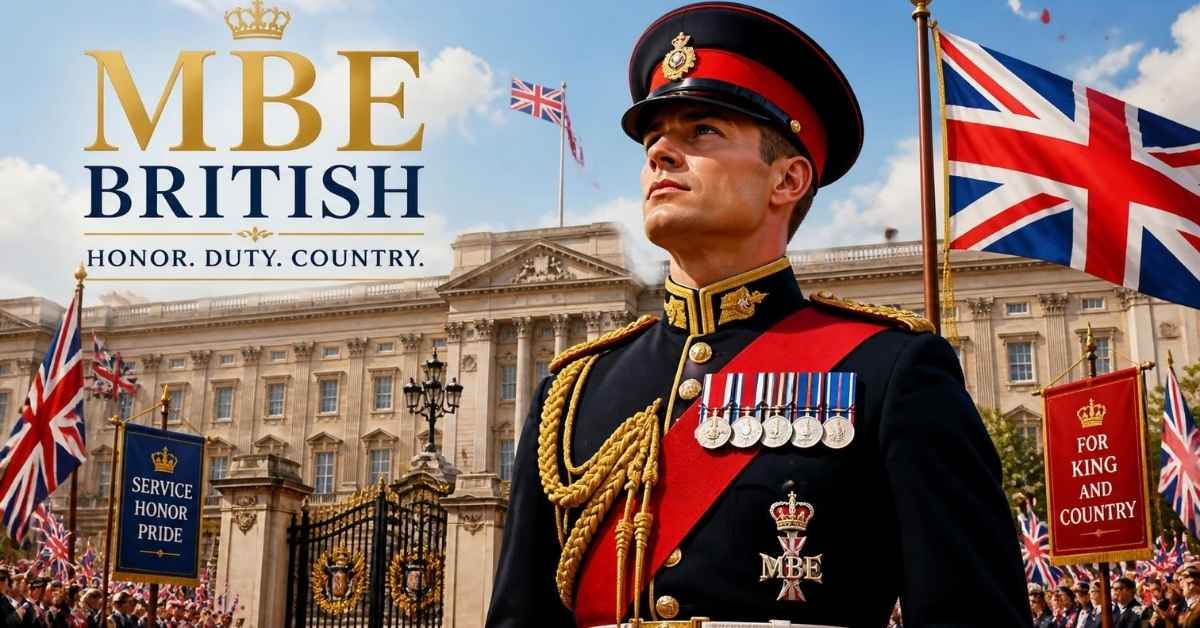
You’ve seen MBE after someone’s name and wondered what it means. Is it a title? Is it a big deal? Who actually gets one? Here’s the short answer. MBE stands for Member of the Order of the British Empire.
It’s an official honour from the British monarch that recognises an outstanding contribution to society. It isn’t a knighthood, and it doesn’t change your legal status. This guide walks you through the full story, from 1917 to your Instagram feed.
Definition & Core Meaning
What Does MBE Mean?
The MBE abbreviation stands for Member of the Order of the British Empire. It’s the fifth and lowest level of the Order of the British Empire.
Don’t let “lowest” fool you. Thousands of people work for decades before they earn that Crown recognition.
Core Meanings of MBE
At its heart, an MBE is a public service award and a form of national recognition. It says the country noticed what you did.
It rewards community contribution and service to society over fame or wealth. Think contribution over status.
Simple Examples
Picture a retired teacher who ran a free homework club for 30 years. Her neighbours nominate her, and the UK honours system says yes.
Now she writes “MBE” after her name on her formal introduction and professional profile. That’s all the letters do.
Historical & Cultural Background
Origins of the MBE
King George V set up the order in 1917, in the middle of World War I. The war had pulled millions of ordinary people into the effort.
The old honours mostly favoured the aristocracy, so the king wanted a way to thank civilian honours earners too.
Evolution Over Time
At first it rewarded military recognition and wartime work. Nurses, factory workers, and volunteers all made the early lists.
Over the decades it shifted toward peacetime service. Today the British honours list appears twice a year, at New Year and in June.
Cultural Interpretations
For many families, an MBE feels like national appreciation wrapped in a medal. It’s a symbolic honour with real emotional weight.
Others see it differently, which we’ll get to soon. The word “Empire” doesn’t land the same way for everyone.
Emotional & Psychological Meaning
Psychological Impact
Getting an MBE can feel like a rush of validation. After years of unseen work, someone finally says “we saw you.”
That can build confidence and a deep sense of belonging. Some recipients say it also feels humbling.
Personal Growth & Identity
Many recipients treat the honour as a checkpoint on a meaningful journey, not a finish line. It reinforces their purpose.
It can shape identity and legacy, too. People often say it motivates them to keep going.
Different Contexts & Use Cases
Personal Life
In everyday life, the MBE recipient rarely mentions it. Most folks mention it only when someone asks.
It might pop up in a toast at a family dinner. Otherwise it stays quiet.
Social Media
On X platform, Instagram, and LinkedIn, social media recognition spreads fast. Viral announcements often bring thousands of congratulations.
Celebrity news also sparks public debate. Some people cheer, others question who deserves what.
Relationships & Family
Families often feel family pride and even generational pride. A grandchild might frame the letter long before the medal arrives.
It becomes a shared achievement, since relatives supported the work behind the scenes.
Professional & Modern Usage
MBE after name appears on CVs, bios, and conference pages. It can boost professional credibility and signal leadership recognition.
Employers and partners often read it as a mark of trust. Still, it works best next to real results.
Hidden, Sensitive, or Misunderstood Meanings
Common Misunderstandings
MBE misconceptions are everywhere. Many people think it makes you “Sir” or “Dame,” but it doesn’t.
It also isn’t a political role or a form of nobility. You don’t get a seat, a salary, or a privilege.
Sensitive Interpretations
Some people link the word “Empire” to colonial associations. Poet Benjamin Zephaniah publicly turned down an OBE in 2003 for that reason.
These views shape post-colonial perspectives and Indigenous perspectives. They matter, and it’s fair to discuss them openly.
When the Meaning Changes
In UK formal settings, an MBE signals respect. In activist circles, it can spark mixed feelings.
The contextual meaning shifts with who’s talking and where. Always read the room.
Comparison Section
MBE Compared to Similar Honours
Here’s how the main levels stack up. The OBE, CBE, and knighthood sit higher on the ladder.
| Honour | Full Name | Level |
| MBE | Member of the Order of the British Empire | Entry level honour |
| OBE | Officer of the Order of the British Empire | Mid level |
| CBE | Commander of the Order of the British Empire | Higher honour |
| Knighthood or Damehood | Knight or Dame (KBE/DBE and above) | Senior honour, comes with Sir or Dame |
The British Empire Medal is a separate medal, not a rank. Neither the Medal of Honour nor any military honour works the same way.
MBE vs knighthood is simple: one gives letters, the other gives a title. MBE vs OBE and MBE vs CBE come down to scale and national reach.
Popular Types / Variations of MBE Recognition
There’s no official “category” menu. Still, MBE categories help explain who gets recognised, so here are ten common types of MBE recognition.
1. Community Service MBE
The community service MBE honours people who show up for their neighbours. Examples include a charity founder running homeless support or a volunteer driver.
It’s pure grassroots leadership and community impact.
2. Arts & Culture MBE
This one celebrates cultural achievements in music, film, literature, and theatre. It protects cultural life and creative expression.
Many recipients also shape national identity through their work.
3. Sports MBE
A sports MBE often goes to athletes, coaches, and Olympians. It’s a nod to sports excellence and years of discipline.
Coaches who mentor kids on muddy pitches get recognised, too.
4. Education MBE
An education MBE rewards teaching impact and educational reform. It also covers digital learning resources that open doors.
Educators who change lives quietly fit here perfectly.
5. Healthcare MBE
The healthcare MBE thanks healthcare workers for medical service and public health contribution. Nurses and paramedics feature often.
It reflects the weight of care work that rarely makes headlines.
6. Charity & Nonprofit MBE
This honour backs charitable organizations and humanitarian work. A charity MBE or nonprofit MBE often follows years of fundraising.
Mental health support groups appear often, as well.
7. Business MBE
The business MBE rewards entrepreneurship and ethical business. Think of a fair wage company that creates local jobs.
It’s about economic contribution that lifts a whole town.
8. Science & Innovation MBE
This MBE honours science research, research advancement, and technology innovation. Work on sustainable energy solutions fits well.
It signals innovation progress that benefits everyone.
9. Youth Work MBE
The youth work MBE recognises mentorship, youth empowerment, and leadership programs. A youth club leader fits the bill.
These folks change futures one kid at a time.
10. Diversity & Inclusion MBE
This award supports social justice advocacy, equality, and representation. It also covers workplace inclusion work.
It’s often linked to social change that feels slow until it isn’t.
Why These MBE Categories Matter
The categories show that the honour isn’t only for stars. It covers dedication, commitment, and service leadership across life.
They remind us that impact over influence is the real test.
How to Respond When Someone Asks About MBE
Casual Responses
Keep it light. Try “It’s a UK honour for service” and move on.
That MBE response example works at parties and on group chats.
Meaningful Responses
If someone asks sincerely, share the story. Say what the work meant and who helped.
A personal response like this shows humility and dedication.
Fun Responses
You can joke, too. “It stands for Mostly Better Eating” gets a laugh, then you explain.
Just don’t mock the honour itself, since it matters to many.
Private or Personal Responses
You don’t owe anyone details. A simple “I’d rather keep it simple” is polite and clear.
Some people see it as a national thank-you note, and that feels private.
Regional & Cultural Differences
Western Perspective
In the UK and many Western culture settings, the MBE reads as a royal honour of public admiration. Some see it as a charming tradition.
Others find it outdated, so debate is normal.
Asian Perspective
In Asian culture, an honour often carries family honour and discipline and service. A relative’s MBE can raise a whole family’s standing.
Reactions also vary across former colonies.
Middle Eastern Perspective
In the Middle East, recognition often connects to diplomatic recognition and state relations. An MBE for an expat can signal global recognition.
Local views depend on history and context.
African & Latin Perspectives
The African perspective often involves historical symbolism tied to colonial rule. People may weigh pride and pain together.
The Latin perspective is usually less familiar, since fewer people know the honour. It mostly reads as international recognition of achievement.
Who Receives an MBE and How to Nominate Someone
Who receives MBE awards? Anyone who made a sustained, outstanding contribution, usually at a local or regional level. You don’t need fame.
Eligibility for MBE usually looks at the impact of the work and how long it lasted.
Anyone can nominate someone through the official UK government process. A clear, specific case with evidence helps a lot.
Committees review nominations, and the British monarch approves the final lists.
Conclusion
The MBE is a symbolic honour with real meaning. It celebrates service to society, not status.
It’s lasting recognition of achievement, and it shows that community impact matters.
So do you know someone who deserves one? Drop a comment, share this with a friend, or tell us your story below.
FAQs
What does MBE stand for?
MBE stands for Member of the Order of the British Empire. It’s an honours and awards title from the UK royal awards system.
Is MBE a title?
No. It’s a post nominal, which means letters that come after your name, not before it. Only knights and dames use Sir or Dame.
Who can receive an MBE?
Anyone who makes a lasting public contribution can be nominated. Most winners are volunteers, workers, and educators.
Can you refuse an MBE?
Yes. People can decline an honour because of personal beliefs or political beliefs. Recipients are usually asked privately before any announcement.
Is MBE recognized outside the UK?
It’s recognised across many Commonwealth countries, though some now run their own systems. MBE outside UK settings often carry international recognition value.
Does MBE change your legal status?
No. It doesn’t give you rank, privileges, or special MBE legal implications. It’s honorary recognition with MBE legacy value only.
